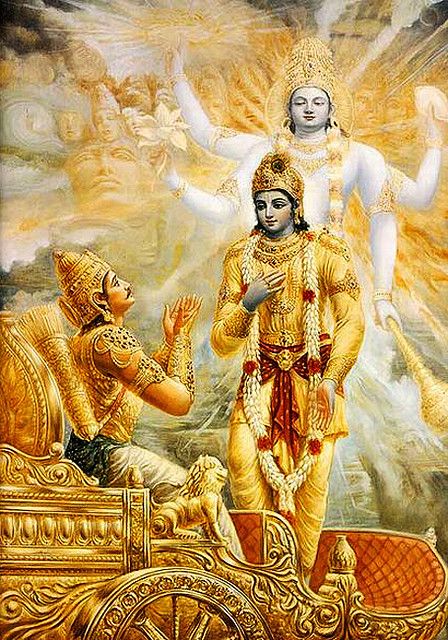
There is extreme tension in the air. The two mighty armies of Kauravas and Pandavas are ready to attack each other in the battleground of Kurukshetra. Suddenly, the mightiest hero of the Pandavas – Arjun – expresses his inability to fight with his Kaurava brothers. He drops his bow and discusses his anguish with his mentor, Lord Shri Krishna. The Lord explains him the divine secret of well-being in the sermon that follows, popularly called as the Bhagwad Gita.
Karma Yoga explained
According to Shri Krishna, every person has a purpose in life, depending on his skills, role in society. This purpose is personal and has to be for the good of the society. Arjun is a warrior, and it is his purpose in life to fight with evil forces to protect righteousness. This purpose or duty has to be carried out with one’s actions – called as Karma. According to the Lord, a person should never worry about results, and perform one’s duty purely to pursue the purpose. If a person performs his Karma without any expectations of a result – good or bad, he is freed from the punishment of sins or rewards of virtuous deeds. A person who performs his Karma without any expectations is called and Karma Yogi and his actions are called Karma Yoga.
What is your purpose in life?
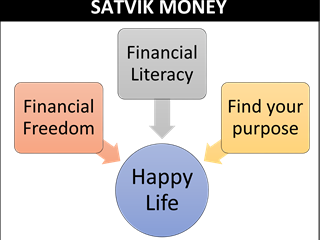
Now how does all of the above lead us to happiness. The secret is that you should follow your purpose in life like a Karma Yogi, which leads us to a path of durable happiness. So the big question is what is our purpose in life. How to find it. Is there a model to find it. The good news is yes – we have a great model to find our purpose and it comes from Japan. The concept is called “IKIGAI”.
IKIGAI:
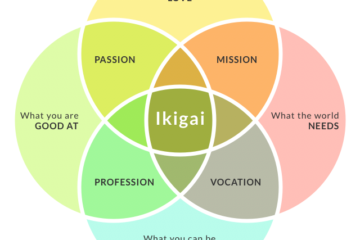
IKIGAI is a Japanese concept of having a purpose in life. It provides fulfilment to a person, gives them satisfaction and a sense of meaning in life.

IKIGAI is an activity, career or profession which satisfies the following four characteristics:
- What you love to do
- What you are good at doing
- What you can be paid for doing, and
- What is needed by the world
IKIGAI, is very personal and differs from person to person. One person’s IKIGAI, or purpose in life cannot be same as another person’s purpose. For example, IKIGAI for a sportsperson like Anil Kumble is his passion towards the game of Cricket. He started by playing professional cricket until his retirement. Then he pursued his purpose of training the youth for achieving excellence in professional cricket.
IKIGAI and Bollywood:
Remember the Bollywood movie, Tamasha. It exemplifies the cause of following your purpose in life.

The movie’s lead character, Ved (Ranbir Kapoor) is leading a confused, routine and mundane life in his corporate job. He secretly loves his own dreams of theatre and acting, which he loved since his childhood. However, due to societal pressure, he is forced to pursue a regular corporate job. However, over time and due to twists and turns in his life, he rediscovers his true passion and purpose in life, leaves his corporate job and plunges himself in his passion towards theatre. The film was a creative but clear depiction of the importance of pursuing one’s purpose or passion in life.
One more movie 3 Idiots, tries to depict the importance of following IKIGAI.

Farhan (R Madhavan) loves wildlife photography and wishes to excel in it as a career. He secretly writes a letter to his mentor and world best wildlife photographer, but never posts it. Due to pressure from his father, he tries to study engineering, in which he has no interest. He does not do well in it. Ultimately, his friend, Rancho (Aamir Khan) persuades his father to let Farhan pursue his passion, as he can only excel in an area of his interest. Farhan’s father ultimately realizes his folly and supports his son’s decision to follow his IKIGAI – career in wildlife photography.
Summary:
The route to durable happiness in life is selfless action (Karma Yoga) towards a person’s purpose in life (IKIGAI)