Dad, why do I need to learn integration in algebra? Will I ever use it? Most parents are asked such questions by their high school children. Kids today are given education in Languages, Math, Science, History, Geography, etc. As parents, we tell our children to study these subjects diligently, as some time in their lives, they will need them. True. But, can you guess a subject which they shall need for their entire lives, that too on a daily basis? If they do not know about this subject, they may face great hardships and may struggle. Everyone needs to know about it. But surprise, surprise! We are never given any formal education about it. Unbelievable, but true!
This subject is ‘Money’ or Financial Literacy. We deal with money day in day out. To pay our electricity bills, earning a salary, depositing it in a bank, buying our favourite ice-cream, etc. As we mature and age, money – earning and spending it starts becoming central to our lives.
Money education or Financial Literacy needs to be universal. Everyone needs it as everyone deals with money. If we learn the nuances of Financial Literacy, we shall be able to move out of the rat race. We can then begin the happy journey towards Happiness, the first step of which is Financial Literacy.
So let’s understand the key concepts quickly in this short and quick guide.

Income:
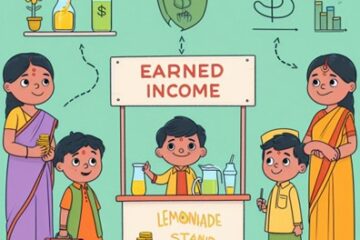
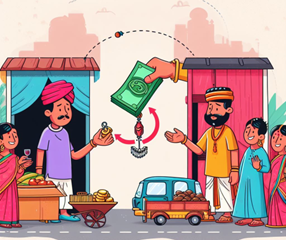
Income is the money we receive for giving our services or renting out something like property or money itself. Income we receive in return for our services rendered is called salary. Income we receive for giving our property for hire to someone else is called rent. Income we receive for giving our money for hire to someone else is called interest.
Income is of mainly two types: 1) Active Income, 2) Passive Income.
Active Income is income earned from our own efforts and work. If we do not work, we would not be able to earn any Active Income. Ways to increase Active Income are a) improving our quality of work done by educating ourselves, b) increasing the quantum of work. For e.g., you can earn more by working overtime or working on a side hustle.
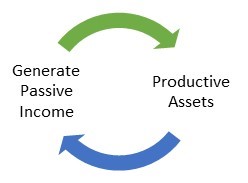
Passive Income is the opposite of Active Income. We earn it while we are asleep. Its earned by things we give out on rent, like our property or our money. Passive income can be increased by optimising your investments, increasing the amount invested in investments, etc.,
Expense:
Expenses are money we spend on buying things like bread, coffee, t-shirts, jeans, our house, etc. Expenses are of three types:
- Needs: Money spent on buying food, clothing or shelter can be classified as needs. We cannot survive without these necessities and hence, everyone spends money to buy them.
- Essential Wants: Money spent on education, communication equipment like a basic mobile phone system, walking stick for an elderly, etc can be classified as essential wants. While essential wants are not needed for survival, they are extremely important to lead a normal or healthy life.
- Wants: Money spent on anything which cannot be classified as needs or essential wants, are classified as wants.
Savings:
Income which is not spent is called as savings.
Income – Expense = Savings
Saving is the most important for achieving our long term objective of happiness. In early stages of a person’s working life, generally income is low and expenses tend to be higher. As he progresses in life, he should try to ensure that the growth in expenses is lower than the growth in income. This will ensure a faster growth in savings, which can be used to generate passive income from investments.
Investments:
Savings which is used to generate more income is called investment. An investment is something which generates passive income for us over a longer period of time. Some examples of investments are: a) Equity or Share in a business, b) Fixed deposit with a bank, c) Property or Real Estate, d) Gold.
Asset:
Asset is a resource owned by a person. Generally, assets are either tangible or intangible. Tangible assets are those that can be touched or felt, like a commercial shop given on rent, Car which can be given on hire, etc.
Intangible assets are those which cannot be touched or felt. Thus, money spent by companies on advertising for creating brands are intangible assets.
However, from our perspective we need to learn about two types of assets:
- Good assets. These are those productive assets which generate passive income for us. All investments belong to this category of assets. Our endeavour should be to accumulate good assets over time, so that they generate a steady stream of passive income for us.
- Bad assets: These assets are ones which do not generate any money for us. These assets include an expensive car for our own travel, money spent on furniture for our house, etc.
Liability:
A liability is money owed by us to someone else. It is mainly loans taken by us, which have to be repaid over time. These are two types of liabilities:
Good liabilities: These are loans taken to purchase a good asset, which in turn generates income for us.
Bad liabilities: These are loans taken to purchase bad assets. We need to avoid these liabilities as much as possible, as they can lead us into ‘Debt trap’.
Hurray! You are now equipped with the basics to start your journey towards happiness driven by financial literacy and financial freedom. All the best.
2 Comments
How Can Money Buy Us Happiness - Foundation of Satvik Money - Satvik Money · April 14, 2021 at 9:26 am
[…] Step 1: Financial Literacy […]
What is Financial Freedom and How to Achieve It – A Quick Guide - Satvik Money · April 14, 2021 at 9:28 am
[…] 1: Start with Financial Literacy, i.e., education yourself about the key money […]
Comments are closed.